Both voices are synthetic. I designed them, auditioned them against the text, and keep them; where the breath falls is directed here, line by line.
Carmilla, chapter one
Some books arrive as text. This one arrives as a voice first.
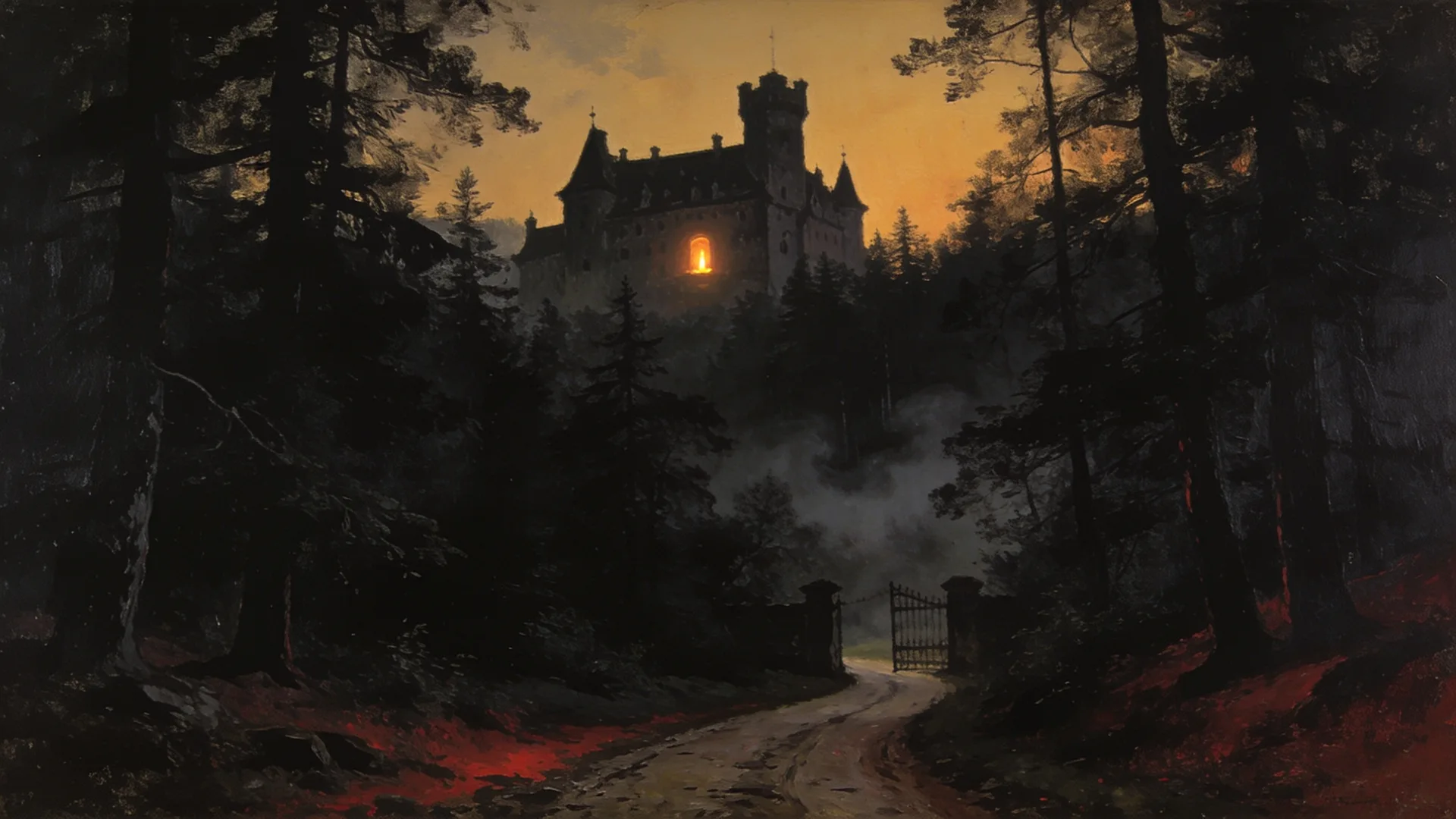
Chapter one belongs to Laura, and it carries two of Le Fanu’s chapters, because they run on without a break. First her childhood: the schloss in Styria, the forest, the night she was six years old and something stood at the foot of her bed and then was not there. Then the walk with her father at dusk, the letter from General Spielsdorf, the unhappiness arriving at the same time as the moon.
Then the crash on the road. A carriage overturns outside the gate, and the mother who climbs out of it is in a hurry, and the girl she carries is hurt. Laura asks for her to stay. The mother will not stay. She leaves her daughter behind with a family she has known for ten minutes, and the carriage whips away into the dark, and nobody in the house asks the one question worth asking.
The words that follow are the end of Le Fanu’s second chapter and the first breath of the third. Laura tells all of it alone, in the first person, the way he wrote her. Carmilla’s first lines come exactly where the text gives them to her: awake on the sofa, asking for her mother, asking where she is.
Thirty minutes and fifteen seconds. Press play.
One more thing, because a chapter that is mostly silence about its own assembly is not honest. The first build of this chapter, in October, skipped Le Fanu’s second chapter. Chapter one went from Laura’s childhood straight to the carriage already leaving, and the house called that complete. It was rebuilt on 28 October 2026: chapter two is in it now, where he wrote it, between the letter and the guest waking up. If you heard the earlier version, the missing piece was a whole chapter, and it was the arrival.
Content warning: a child is hurt and frightened in the opening pages.
Le Fanu’s novel is in the public domain.