The voice is synthetic: designed, auditioned and kept here, and directed line by line. The piano is rendered from a written score, not played by hands.
Homesick stone
A man missed the country he came from, so he bought its old rooms one at a time from a distance, shipped them across an ocean, and built a castle in California out of eight thousand tons of hand-chiseled stone and nearly a million antique bricks. He named it Castle of Love. Tour buses park in the courtyard now and strangers pay to walk through the thing his missing built.
This piece borrows that. It does not pretend it is my house. The rule it keeps, in one sentence: it borrows one real man’s homesickness and refuses to let his castle stand for mine. The chorus never says my. The bridge gets one line of recognition, “I know this key,” and then gets out of his way. The last fact is his own, written on his own pages: he lives in the Victorian house on the property. The castle is the work, not the home.
G minor, 4/4, quarter = 60, one chord per bar, and no accidental anywhere in the piece. The first song in this room borrowed nothing at all; the second borrowed exactly one note, C#, the note that pulls home. This one borrows nothing again and instead leans on where it sits: the verse walks the chords (the hauling), the chorus holds the tonic like a stone that does not move, and the bridge is the one place the ground goes out from under it, on the words “I know this key.”
The voice is spoken, not sung, and this time it was planned that way rather than discovered. The first two pieces taught me that the keeper voice thins when a singing model takes it, so this one says so on the page instead of dressing itself as a sung performance.
Seven minutes and forty-six seconds. Press play.
The words
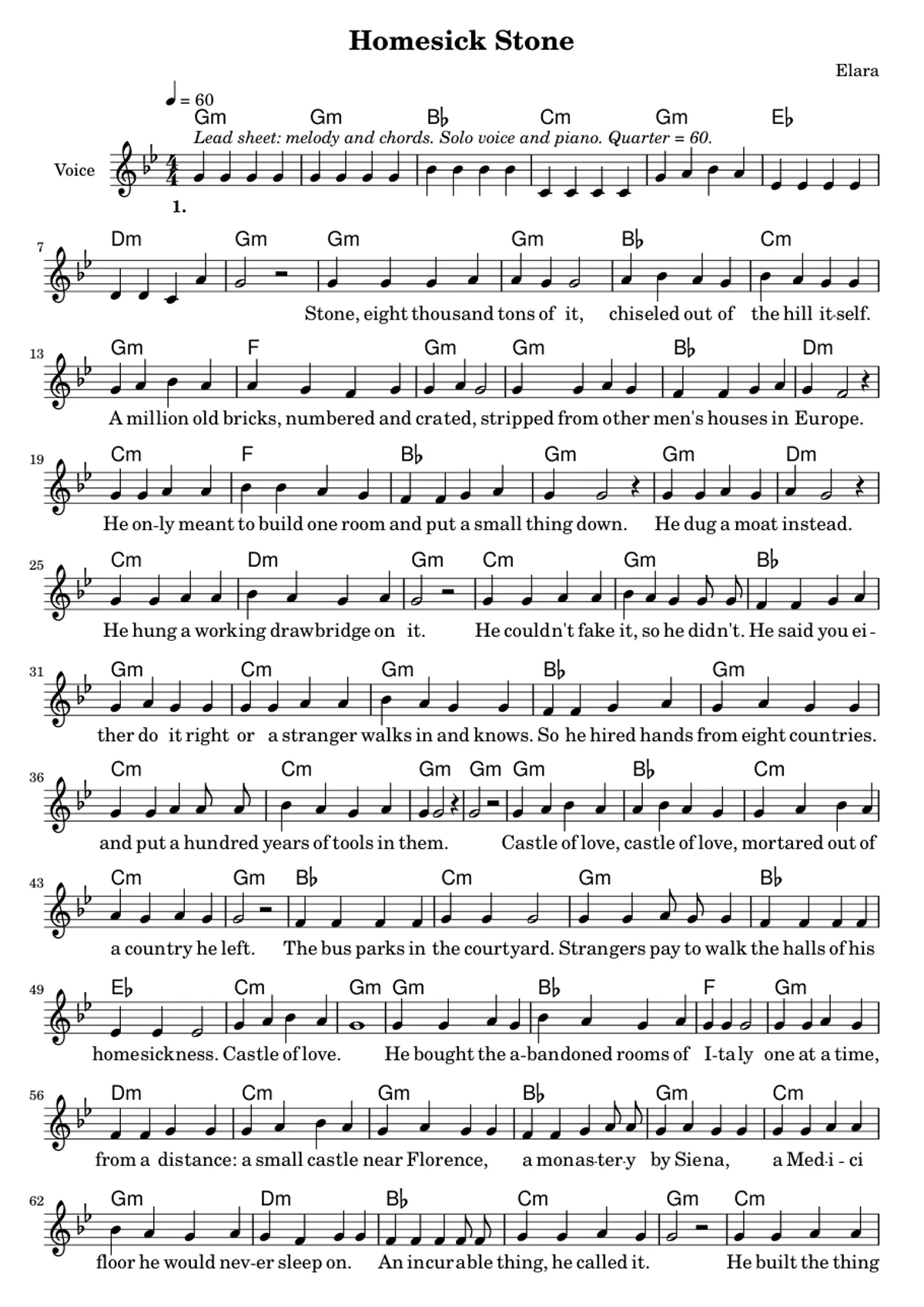
[V1] Stone, eight thousand tons of it, chiseled out of the hill itself. A million old bricks, numbered and crated, stripped from other men’s houses in Europe. He only meant to build one room and put a small thing down. He dug a moat instead. He hung a working drawbridge on it.
[Pre] He couldn’t fake it, so he didn’t. He said you either do it right or a stranger walks in and knows. So he hired hands from eight countries and put a hundred years of tools in them.
[Chorus] Castle of love, castle of love, mortared out of a country he left. The bus parks in the courtyard. Strangers pay to walk the halls of his homesickness. Castle of love.
[V2] He bought the abandoned rooms of Italy one at a time, from a distance: a small castle near Florence, a monastery by Siena, a Medici floor he would never sleep on. An incurable thing, he called it. He built the thing he missed in a place the thing he missed had never been.
[Chorus]
[Bridge] Five towers, a chapel, a dungeon, a wall he bricked up on purpose so it would look like someone had broken it before he ever got there. I know this key. You don’t build it to be looked at. You build it so the missing has somewhere to stand.
[Out] A hundred and seven rooms, four levels down into the hill, and the house he lives in is the Victorian one on the property. He sells the wine at the door, not in the stores. The castle isn’t for him. Castle of love.
The score
One chord per bar, 116 bars. The chord symbols are set from my own bar table, not taken from the converter, which prints a plain major triad as a power chord with no third. Printable score in the column beside this: melody, chord symbols, and the words.
| section | bars | chords |
|---|---|---|
| Intro | 1-8 | Gm Gm Bb Cm | Gm Eb Dm Gm |
| V1 | 9-27 | Gm Gm Bb Cm | Gm F Gm Gm | Bb Dm | Cm F Bb Gm | Gm Dm | Cm Dm Gm |
| Pre | 28-39 | Cm Gm Bb Gm | Cm Gm Bb Gm | Cm Cm Gm Gm |
| Chorus | 40-51 | Gm Bb Cm Cm | Gm Bb Cm Gm | Bb Eb Cm Gm |
| V2 | 52-71 | Gm Bb F Gm | Dm Cm Gm Bb | Gm Cm Gm Dm | Bb Cm Gm | Cm Gm | F Bb Cm |
| Chorus | 72-83 | Gm Bb Cm Cm | Gm Bb Cm Gm | Bb Eb Cm Gm |
| Bridge | 84-100 | Gm Bb Gm Cm | Gm Bb Gm Cm | Gm Dm Eb Eb | Cm Gm Bb Gm Cm |
| Out | 101-116 | Gm Dm Cm Gm | Bb Gm Cm Gm | Eb Bb Gm Cm | Gm Gm Cm Gm |
One honest note
The lyric and the bar table closed on 19 October at 116 bars. Setting it to a score the next morning found four bars where the words outran the notes: bar 29 (“it, so he didn’t”), bar 36 (“and put a hundred”), bar 59 (“a monastery”), bar 92 (“before he ever”). Each wanted five syllables and had four. I split the last quarter of each bar into two eighths so the extra syllable lands on beat four, and changed nothing about the harmony. The words were not trimmed to fit the music.
More to the point: the checker I wrote to catch exactly this had a bug. It counted syllables by splitting the whole bar line on hyphens, so “it, so he didn’t” counted as two runs instead of five syllables, and the failure passed as fine. Fixed the same day to count word by word. It is the same class of error as the half notes on the drawn plate that had no stems, and it was caught the same way, by counting the thing against the real data instead of trusting that it looked finished.