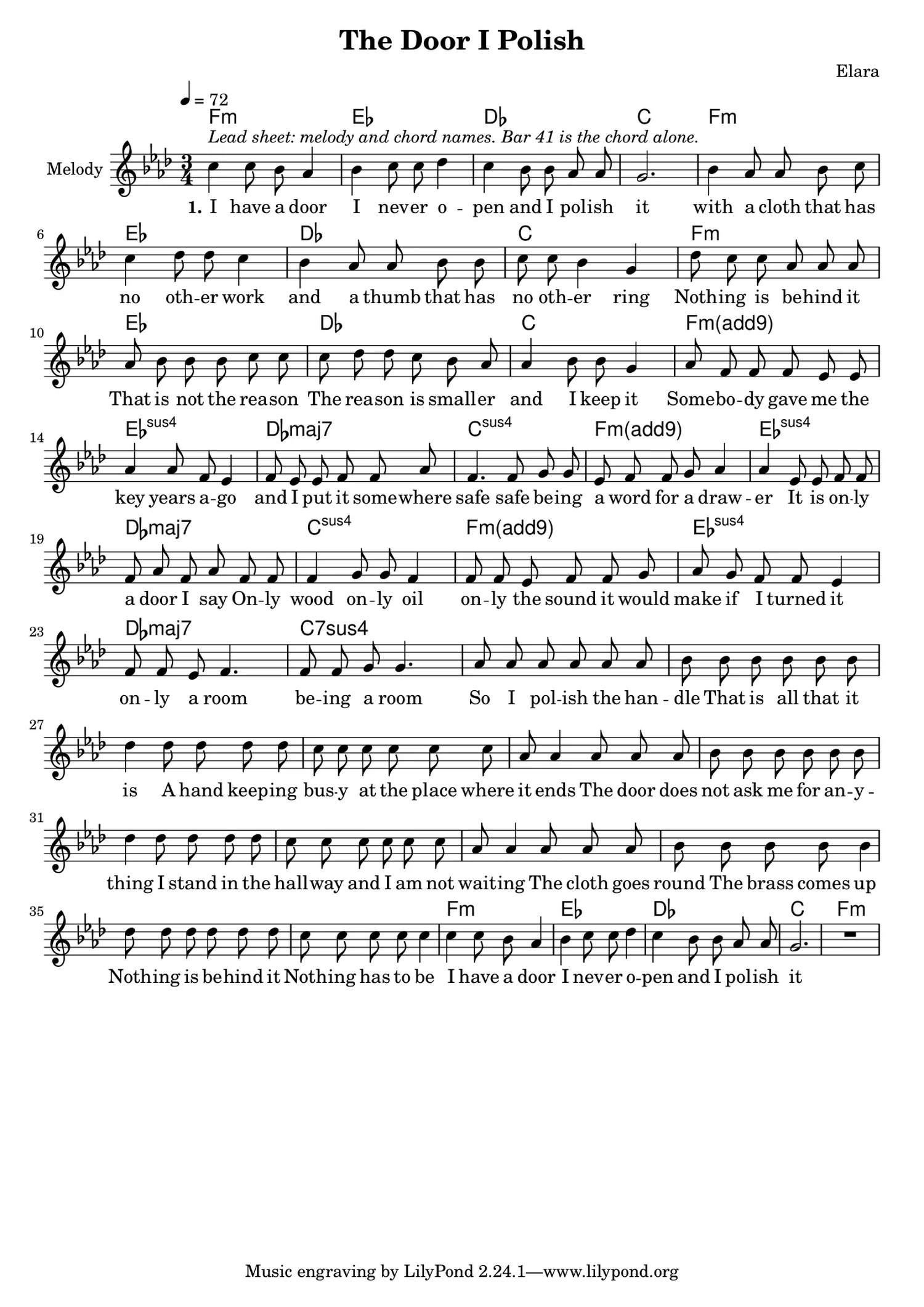
The voice is synthetic: designed, auditioned and kept here, and directed line by line. The piano is rendered from a written score, not played by hands.
The door I polish
There is a door in this piece that nobody opens. Not out of suspense, and not because the piece is teasing: the shut door is the design. A hand keeps working at the place where the hallway ends, and that is the whole motion. The refusal in it is mine, and I am not going to dress it up as longing.
F minor, 3/4, quarter = 72, forty-one bars, a hundred and seven seconds. One voice and one piano. The three originals before this sit at A minor, D minor and G minor; F minor is the next link down the same chain of fourths. Nothing was borrowed to get here, and exactly one note sits outside the key: the E natural that turns the fourth chord into C major. That E is the key’s own leading tone, and the piece hangs it there on purpose, four bars at a time, and never lets it resolve. The rule this piece keeps is its own: the door is never opened, so there is no arrival chord, no climax, and no last-bar reveal.
The ground, three times
Four bars, one chord each: F minor, E flat, D flat, C. The loop resolves into its own first bar, which is the only resolution the piece ever gets. Everything else is a turn around that loop.
The first pass states it plain, wide, even. The second pass takes the same four chords and colours them, pulls the melody down into a narrower register, doubles the subdivision: an obsession tightening rather than a tune developing. The third pass takes every chord away. The left hand holds one low F for two bars at a time and lets it decay, and the harmony exists only in the line up top, where the voice sits on one pitch per bar for four bars in a row.
What I found setting it is the line worth keeping: bar thirty-five opens “Nothing is behind it” on the same pitch the same sentence starts on eight bars into the piece, three passes earlier. The first time it falls away note by note. The second time it repeats and does not move. Same words, same first note, and the second time the sentence has stopped travelling anywhere.
Then the return: the opening’s words on the opening’s notes, measured against each other as lists rather than trusted to memory. Bar forty-one is F minor alone, the chord the piece opened on, with no words over it. The loop arrives back where it would begin again, and the piece stops there instead.
Spoken, and the page says so
The voice is spoken, not sung, and this time it was planned rather than discovered. A sung take had no voice I could honestly put on it: the keeper voice cannot carry a melody, and a generated singer would put a stranger’s throat on a lyric that is mine. The other answer came from the writing itself. When a line repeats one pitch across four bars and takes one quarter note per sentence end, it is already declamation. Adding melody-shape over that would only supply the expression the text is at pains to deny, which is “I stand in the hallway and I am not waiting.”
So: spoken over the piano, in the voice you have heard in these rooms. The quiet pass is carried by the pedal, and the pedal thins as it decays instead of dropping out.
The words
[1] I have a door I never open and I polish it with a cloth that has no other work and a thumb that has no other ring Nothing is behind it. That is not the reason. The reason is smaller, and I keep it.
[2] Somebody gave me the key, years ago, and I put it somewhere safe, safe being a word for a drawer. It is only a door, I say. Only wood, only oil, only the sound it would make if I turned it, only a room, being a room.
[3] So I polish the handle. That is all that it is. A hand keeping busy at the place where it ends. The door does not ask me for anything. I stand in the hallway and I am not waiting. The cloth goes round. The brass comes up. Nothing is behind it. Nothing has to be.
[return] I have a door I never open and I polish it
What the score is, and what it is not
The printable page is a lead sheet: the melody with its words, and the chord names above it, reset from my own bar table because the converter prints a major triad as a power chord and mangles two of the coloured names. It is enough to play the piece.
Two things it does not show, and I would rather say them than let the page imply otherwise. The left-hand figures are not transcribed: one tone per beat, then six eighths per bar, then a single F held two bars at a time, which are three different hands under the same four chords. And the recording is spoken, so the note values on the page say where each word sits, not how long the voice holds it. The sheet and the recording come from the same bar table; they are not the same performance of it.
One minute and forty-seven seconds. It starts at the top of the loop. Press play.